Bird of Paradise: what your moisture meter reading means
The healthy band for a bird of paradise, on whichever scale your meter prints — and, more usefully, what the same number means in different situations.
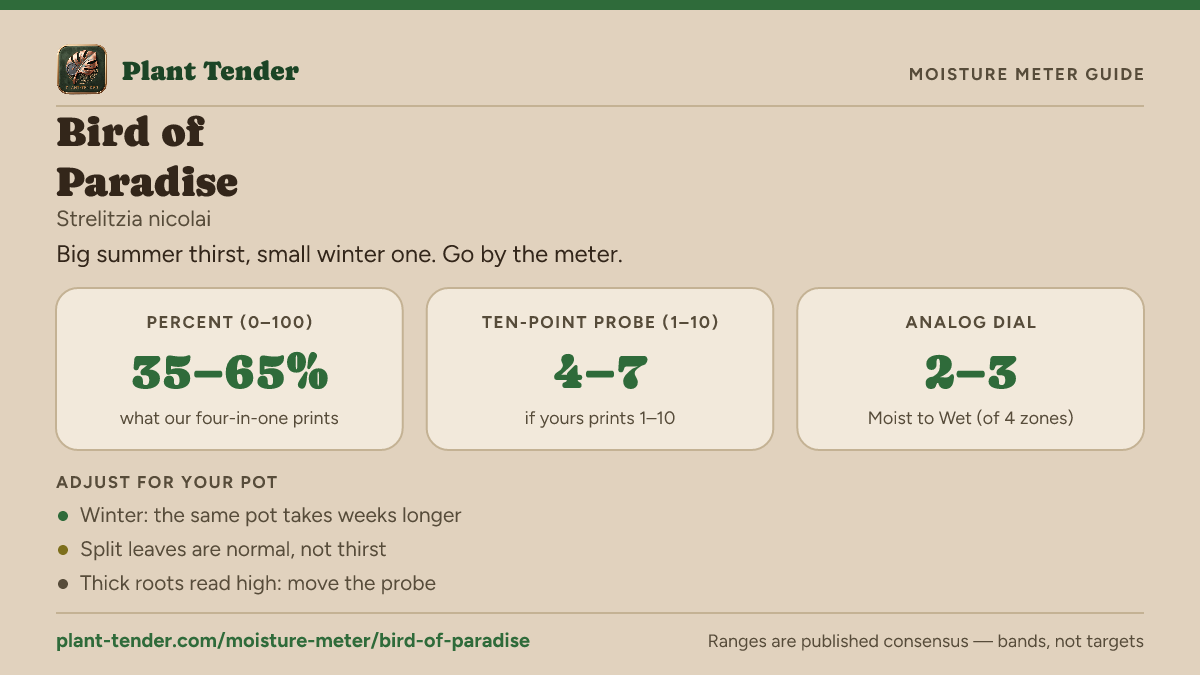
Percent (0–100)
35–65%
what the four-in-one we recommend prints
Ten-point probe (1–10)
4–7
if your probe prints a bare 1–10 sweep
Analog dial
2–3
Moist to Wet — of 4 zones
That is the band you are aiming for, not a target to hit exactly. These ranges are published horticultural consensus and are deliberately banded wide — these are unpowered galvanic probes, two of them in the same pot routinely disagree, and fertilizer salt raises the reading with no extra water present.
Got the plant in front of you? Point your camera at it — Plant Tender names what is in the pot from one photo and gives you the numbers it wants. No account, no card.
What each reading means for a bird of paradise
A bird of paradise wants water below 35% and starts staying wetter than it likes above 65%. If your probe prints a bare 1–10 sweep instead of a percentage, that works out like this.
| Reading | For this plant | What to do |
|---|---|---|
| 1 | Bone dry | Well past dry. Water thoroughly now — look for leaves that curl lengthwise along the central rib instead of lying open. |
| 2 | Thirsty | Dry enough to water. Water on the next check unless you watered in the last day or two. |
| 3 | Thirsty | Dry enough to water. Water on the next check unless you watered in the last day or two. |
| 4 | In the healthy band | Inside the healthy band. Leave it — the useful question is whether this number is falling since last time. |
| 5 | In the healthy band | Inside the healthy band. Leave it — the useful question is whether this number is falling since last time. |
| 6 | In the healthy band | Inside the healthy band. Leave it — the useful question is whether this number is falling since last time. |
| 7 | Wetter than ideal | Wetter than ideal. Fine a day or two after watering; a concern if it has been a week. |
| 8 | Wetter than ideal | Wetter than ideal. Fine a day or two after watering; a concern if it has been a week. |
| 9 | Saturated | Saturated. If this has not fallen in several days, check drainage before you change anything else. |
| 10 | Saturated | Saturated. If this has not fallen in several days, check drainage before you change anything else. |
Every row here is worked out from this plant's own numbers — a bird of paradise at 4 and a snake plant at 4 are in genuinely different situations.
The number depends on your soil, and most charts ignore that
A bird of paradise is usually in well-draining potting mix with bark and perlite, in a large pot.
A bird of paradise has thick, fleshy roots that store water, and a large plant moves a lot of water out through its big leaves in warm, bright weather. The result is a plant whose thirst changes with the seasons more than almost anything else on this list. In summer, in a bright window, a mature plant can take its pot from the top of the band into the thirsty rows within a week. In winter the same pot in the same spot can hold a mid-band reading for three weeks or more. The mix does not change; the drinking does.
Adjusting for your mix
Bark and perlite mix: the range on this page applies, and the pot drains and falls at a readable pace. Dense potting soil in a large pot: readings hold high for a long time in winter, which is when rot sets in, so let it reach the bottom of the band before watering. A pot packed with roots: the fleshy roots crowd out the soil and can bulge or even crack a plastic pot, and a root-bound plant dries much faster than its pot size suggests. In winter: stretch the gap between waterings, and let the meter tell you by how much.
Plant Tender asks which of these your pot is in — dense potting soil, chunky aroid mix, bark / orchid mix, semi-hydro / pon, succulent / cactus grit — and applies the adjustment for you, along with a probe-depth target from your pot size.
Where to put the probe
Two-thirds of the way down, halfway between the stems and the pot wall, and take a second reading on the opposite side. These are big pots, and the two sides can differ by a couple of points. The roots are thick and fleshy, and a probe that lands against one reads the water inside the root, which is always high; if the number jumps the moment the probe goes in, move it a couple of inches.
How a bird of paradise actually fails
Summer watering carried into winter. The plant slows right down as the light drops, the pot stops drying, and the fleshy roots begin to rot while the leaves still look fine. The signs come later: lower leaves yellow and brown from the edges, and the base of the stems turns soft or dark. Two things are regularly mistaken for trouble. Leaves that split along their veins are normal for this plant, since the splits let wind through in the wild, and they happen more in dry air or where people brush past. Leaves curling inward along their length mean thirst or very dry air, not rot.
Common situations
The leaves on my bird of paradise are splitting. Is it thirsty?
Probably not. Splits along the veins are a normal feature of this plant, and a large bird of paradise indoors will almost always have some. Check the meter: if it reads between 4 and 6, the soil is fine and there is nothing to fix. Splits tend to increase in very dry air and where the leaves get knocked. They do not heal, so judge any change by the new leaves.
It reads 6 in winter and I watered two weeks ago.
Leave it. A 6 is inside the band, at its upper end, and in winter light a large plant drinks a fraction of what it does in summer. A pot that dropped from 6 to 3 in a week in July can take three weeks or more to do the same now. Wait until it drops to 3, the first of the thirsty rows, and water then. Watering at the summer pace is the most common way this plant is lost indoors.
The leaves are curling inward and it reads 3.
That is thirst: on this page 3 is in the thirsty rows. Water slowly and thoroughly until it runs from the drainage hole, since a big pot takes a lot of water to wet the whole root ball, and the leaves should open back out over a day or two. If the leaves curl while the meter reads 5 or 6, the soil is not the cause; look for dry air, a heating vent, or a sudden move into hot direct sun.
One reading can't be trusted. How fast the pot dries out can.
Everything above is really one argument: a single number from a cheap conductivity probe is not a measurement, it is a data point with a large error bar. Fertilizer salt raises it. Air gaps in chunky mix lower it. Probe depth moves it several points. Two meters in the same pot disagree.
What survives all of that is the trend. The same meter, in the same spot, in the same pot, read over a few weeks, tells you how fast your bird of paradise in this specific mix in this specific room actually dries — and that is the thing that answers "do I water it", which no chart can do for you.
Stop looking it up. Point your camera at your bird of paradise.
The bands above are for bird of paradise in general. Plant Tender gets there from a photo instead: one shot of what is actually in the pot, and it names the plant and gives you the soil-moisture, soil-temperature and light numbers that plant wants. Your first scan needs no account and no card.
Scan a plant — free, no accountAlready know what it is? Save it to Plant Tender and it remembers what your bird of paradise read last time, then tells you water or leave-it-be — so you are reading a trend instead of interpreting one number in isolation. Free for your first three plants.
Ranges come from Plant Tender's per-species dataset, which is version-controlled and reviewed in public — Strelitzia nicolai, 35–65% moisture, 61–78°F soil temperature, bright, some direct sun light.