Orchids: what your moisture meter reading means
The healthy band for orchids, on whichever scale your meter prints — and, more usefully, what the same number means in different situations.
 Plant Tender plant-tender.com/moisture-meter/orchids
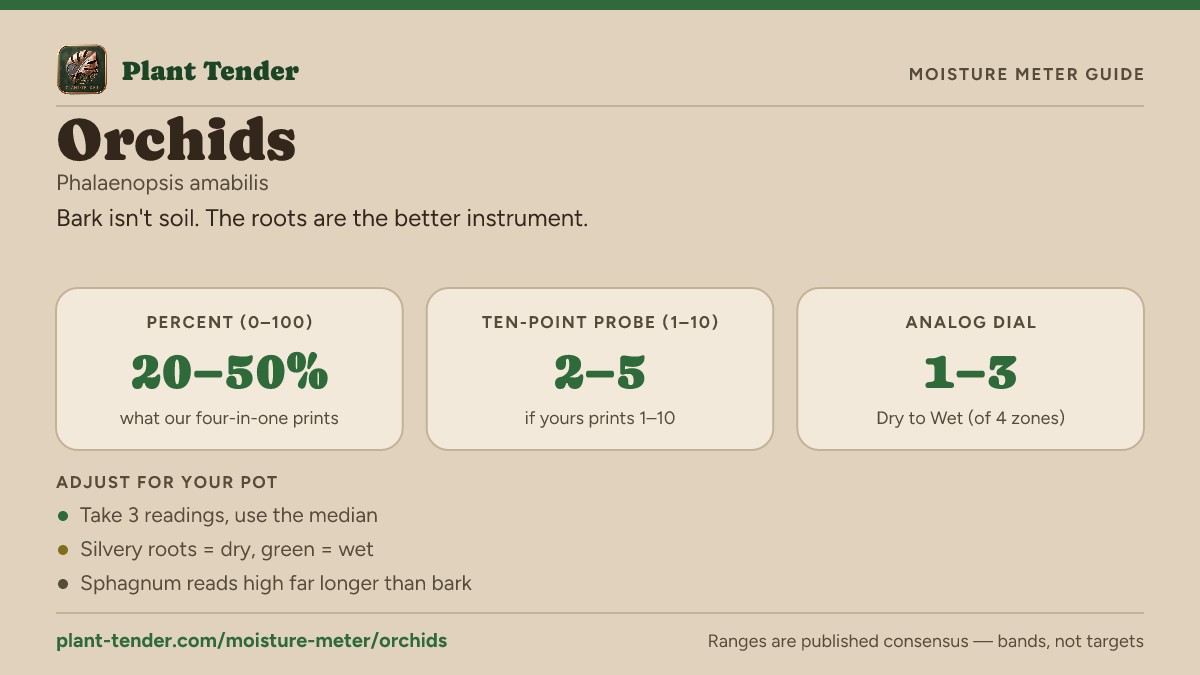
Percent (0–100)
20–50%
what the four-in-one we recommend prints
Ten-point probe (1–10)
2–5
if your probe prints a bare 1–10 sweep
Analog dial
1–3
Dry to Wet — of 4 zones
That is the band you are aiming for, not a target to hit exactly. These ranges are published horticultural consensus and are deliberately banded wide — these are unpowered galvanic probes, two of them in the same pot routinely disagree, and fertilizer salt raises the reading with no extra water present.
Got the plant in front of you? Point your camera at it — Plant Tender names what is in the pot from one photo and gives you the numbers it wants. No account, no card.
What each reading means for orchids
Orchids want water below 20% and start staying wetter than they like above 50%. If your probe prints a bare 1–10 sweep instead of a percentage, that works out like this.
| Reading | For this plant | What to do |
|---|---|---|
| 1 | Thirsty | Dry enough to water. Water on the next check unless you watered in the last day or two. |
| 2 | In the healthy band | Inside the healthy band. Leave it — the useful question is whether this number is falling since last time. |
| 3 | In the healthy band | Inside the healthy band. Leave it — the useful question is whether this number is falling since last time. |
| 4 | In the healthy band | Inside the healthy band. Leave it — the useful question is whether this number is falling since last time. |
| 5 | In the healthy band | Inside the healthy band. Leave it — the useful question is whether this number is falling since last time. |
| 6 | Wetter than ideal | Wetter than ideal. Fine a day or two after watering; a concern if it has been a week. |
| 7 | Wetter than ideal | Wetter than ideal. Fine a day or two after watering; a concern if it has been a week. |
| 8 | Saturated | Saturated. If this has not fallen in several days, check drainage before you change anything else. |
| 9 | Saturated | Saturated. If this has not fallen in several days, check drainage before you change anything else. |
| 10 | Saturated | Saturated. If this has not fallen in several days, check drainage before you change anything else. |
Every row here is worked out from this plant's own numbers — orchids at 4 and a snake plant at 4 are in genuinely different situations.
The number depends on your soil, and most charts ignore that
Orchids are usually in chunky bark, sphagnum moss, or a mix — not soil in any sense.
A moisture meter is at its least reliable on a phalaenopsis, and that is worth saying plainly rather than burying. The probe is designed for soil and an orchid is potted in bark chips with large air voids, so contact is intermittent and readings jump several points depending on whether the pin happens to be touching a chip or spanning a gap. Sphagnum behaves completely differently again and reads much higher for much longer.
Adjusting for your mix
Bark: readings are erratic and run low; take three readings in different spots and use the median. Sphagnum moss: readings run high and stay high for a week or more — a moss-potted orchid at a mid reading may be genuinely wet, and moss holds water long enough to rot roots that bark never would. Clear plastic pot: skip the meter entirely and read the roots, which is what the clear pot is for.
Plant Tender asks which of these your pot is in — dense potting soil, chunky aroid mix, bark / orchid mix, semi-hydro / pon, succulent / cactus grit — and applies the adjustment for you, along with a probe-depth target from your pot size.
Where to put the probe
Down the side of the pot toward the center, past the top layer of bark. Take multiple readings — this is the one species on the list where a single reading should not be trusted at all. Do not force the probe through the root mass; phalaenopsis roots are thick, brittle and easily broken, and a damaged root is a rot entry point.
How orchids actually fail
Crown rot and root rot, both from water sitting where it should not. Crown rot starts as a soft dark patch in the center where the leaves meet, usually because water was poured over the top and sat there overnight — it kills the plant outright and quickly. Root rot shows as roots that are brown, flat and hollow rather than plump; mushy and falling apart when squeezed. Healthy roots are firm and plump, silvery-white when dry and bright green when wet.
Common situations
My orchid reads 6 in bark — is that wet?
Maybe, and the roots will tell you faster than the meter. Bark gives unreliable contact, so a 6 might be a pin resting against a genuinely wet chip in a pot that is otherwise drying. Look at the roots through the pot instead: bright green means wet, silvery-white means ready for water. On a phalaenopsis the roots are a better instrument than the probe, and using them is not a workaround — it is the correct method.
How often should I water an orchid if the meter is unreliable?
Water when the roots go silvery, which in a bark mix in an average home is roughly weekly and in sphagnum considerably less often. Use the meter for the trend rather than the number: if today reads meaningfully lower than three days ago across several spots, the pot is drying on schedule. Never water on a fixed calendar — the same orchid dries in half the time in summer.
The leaves are wrinkled but the meter reads high.
That is the orchid version of the peace lily problem: wrinkled leaves in a wet pot means the roots have rotted and can no longer take up the water that is present. Unpot it and look. Firm plump roots mean something else is going on; brown hollow ones that collapse when squeezed mean root loss, and the treatment is to cut the dead roots away and repot into fresh bark, not to water more.
One reading can't be trusted. How fast the pot dries out can.
Everything above is really one argument: a single number from a cheap conductivity probe is not a measurement, it is a data point with a large error bar. Fertilizer salt raises it. Air gaps in chunky mix lower it. Probe depth moves it several points. Two meters in the same pot disagree.
What survives all of that is the trend. The same meter, in the same spot, in the same pot, read over a few weeks, tells you how fast your orchids in this specific mix in this specific room actually dry — and that is the thing that answers "do I water it", which no chart can do for you.
Stop looking it up. Point your camera at your orchids.
The bands above are for orchids in general. Plant Tender gets there from a photo instead: one shot of what is actually in the pot, and it names the plant and gives you the soil-moisture, soil-temperature and light numbers that plant wants. Your first scan needs no account and no card.
Scan a plant — free, no accountAlready know what it is? Save it to Plant Tender and it remembers what your orchids read last time, then tells you water or leave-it-be — so you are reading a trend instead of interpreting one number in isolation. Free for your first three plants.
Ranges come from Plant Tender's per-species dataset, which is version-controlled and reviewed in public — Phalaenopsis amabilis, 20–50% moisture, 61–78°F soil temperature, medium indirect light.